A Love Letter to Tajinaste
Published:
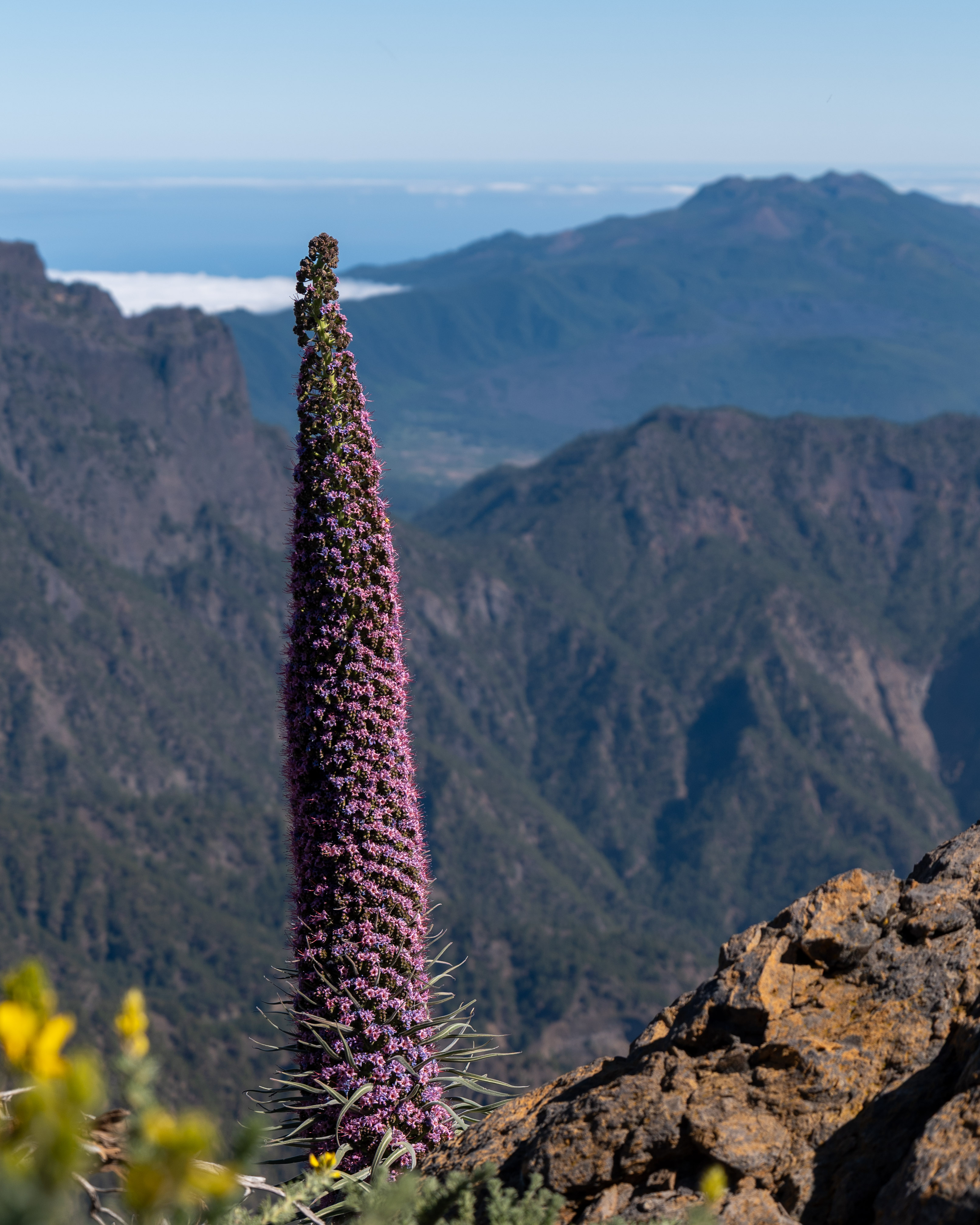
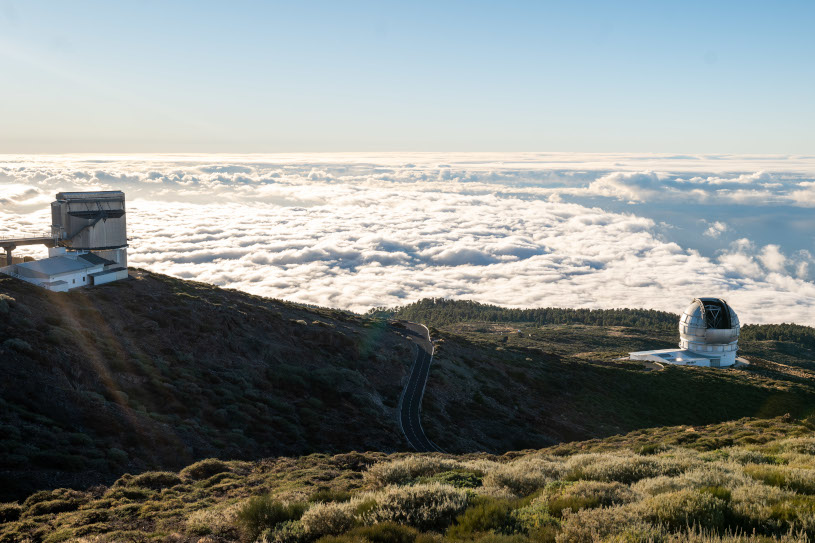
Anybody who has been lucky enough to visit the Roque de Los Muchachos during the late spring will be familiar with the towering pink flowers known locally as tajinaste. I fell in love with these plants during my year living on the island, as have many other astronomers and visitors to the island before me.
Pink tajinaste are endemic to, and can be found only in, the sub-alpine regions of La Palma, from around 2000 metres above sea level up to the peak of the island. For most of the year they exist as dry shrubs, often seen at the side of the road to the Roque. Then, for a few weeks in the spring, they explode into life with beautiful pink-blue flowers, before dying. When fully grown they can be 2–3 metres tall and are filled with life, being a popular source of nectar for local bees (which themselves have a striking black and white colouration).
Different islands across the Canaries have their own forms of tajinaste in a wide range of colours. Tajinaste on Tenerife are similar to those in La Palma, but their flowers are a vibrant red. Blue tajinaste can be found on La Gomera and white tajinaste on Gran Canaria.
Despite a lot of local knowledge of these plants, I found there was a limited amount of easy accessible information online. I spent a few days compiling this information to improve the wikipedia pages of a few species and figured this was a good excuse to make a blog post and show off some pretty photos as well. I am not a botanist, and many things here will likely be either oversimplified or wrong, but if you are or know any that could help improve this post then get in touch
Tajinaste?
Tajinaste is a borrowed term from Guanche, an extinct language spoken by the inhabitants of the Canary Islands before their colonisation from the Spanish. There are some folk etymologies which relate the term to various Guanche terms but as far as I can tell its exact origin is unclear.
As mentioned above, the term tajinaste is used for a wide variety of plants in the Canaries. All of them are part of the same genus (Echium) and form large towers of dense, colourful flowers. Echium is a very large genus, with around 70 recognised species, including Viper’s Bugloss (Echium vulgare) which is native to the UK.
Some Taxonomy (it’s not boring I swear)
The relationship between the different species of tajinaste is somewhat complex, and there has been debate over whether the pink tajinaste of La Palma are a species in their own right or merely a sub-species or variety of those found on Tenerife (Echium wildpretii).
The first scientific description of pink tajinaste to be published comes from the Scottish botanist Thomas Archibald Sprague in 1914, where he identifies it as a species and gives it the name Echium perezii. Sprague carried out a botanical expedition to Tenerife and La Palma in 1913, with an initial report in the Bulletin of Miscellaneous Information published by the Royal Botanical Gardens (Kew Garden).1 If you’ve spent any time on La Palma this is a really fun read, with some great comments on the beauty of the island interspersed with enthusiastic descriptions of various plants which they come across and some fun anecdotes about the logistics of exploring the island in the early 20th century.
Back to the point, Sprague considered the La Palma tajinaste to be its own species. Later in the 1950s and 70s various botanists considered it as either a variety (E. bourgaeanum var. trichosiphon) or sub-species (E. wildpretii subsp trichosiphon) of the Tenerife tajinaste.
A study in 2021 carried out genetic and morphological analysis of various samples of tajinaste from Tenerife and La Palma. They show that the La Palma samples have much greater genetic diversity than those on Tenerife, and combine that with an argument based on the presence of a sister species on La Palma to argue that E. perezii should be considered a species in its own right, and that it likely originated on La Palma before migrating to Tenerife and evolving into E. wildpretii.2
They also make an excellent point that both species would be considered Vulnerable under IUCN criteria D2, due to their very restricted area of occupancy.
References
Sprague, T. A., & Hutchinson, J. (1913). A Botanical Expedition to the Canary Islands, 1913. Bulletin of Miscellaneous Information (Royal Botanic Gardens, Kew), 1913(8), 287–299. https://doi.org/10.2307/4118440 ↩
Graham, R. E., Reyes-Betancort, J. A., Chapman, M. A., & Carine, M. A. (2021). Inter-island differentiation and contrasting patterns of diversity in the iconic Canary Island sub-alpine endemic Echium wildpretii (Boraginaceae). Systematics and Biodiversity, 19(5), 507–525. https://doi.org/10.1080/14772000.2021.1877847 ↩