Observing on La Palma
Published:
Introduction
Since starting my PhD in 2022, I’ve spent quite a lot of time at observatories, just over 100 nights. Most of which were at the Observatorio del Roque de los Muchachos on the island of La Palma. I’m often asked about the experience of travelling to, observing at, and living on La Palma and so I wanted to summarise some of my thoughts in an easy to share way.
This isn’t meant to serve as a definitive guide to the island, I lived there for only a year and mostly socialised with other astronomers. Similarly it won’t remain accurate forever, I imagine that many of the details I mention will change over time and eventually the observatory will be unrecognisable from its description here. But I hope that for the time being this post will be of some interest or utility for the interested astronomer.
Terminology
The Observatorio del Roque de los Muchachos goes by many names. In English it is translated as the Roque de Los Muchachos Observatory, or just ‘the Roque’ for short. It is also commonly referred to by its Spanish acronym, the ORM. Throughout this post and the rest of my life I will use these names interchangeably, or just call it ‘the observatory’.
Travel
The most difficult part of travelling to the ORM is first reaching La Palma. While some observatories are a long drive from the nearest city and airport, it takes only about an hour to reach the Roque by car from sea level.
Travel to La Palma on the other hand can be difficult, depending on where you are travelling from. All information given here about flights is subject to change in the future, but I’ll be describing my experience with travelling to the observatory between 2022 and 2026. During parts of the year, there is a direct flight from the UK once a week from Manchester and Gatwick. For people based near either of these airports this is the simplest option, but requires a fairly rigid schedule. When working on GOTO we often travelled at the last minute and with strange and restrictive requirements on days of travel which make those flights impossible.
Flights
Our preferred route is to first fly to Tenerife, the most populous of the Canary Islands and also very popular with tourists form the UK. As such there are multiple flights per day from most international airports in the UK. The University of Warwick is located less than a 30 minute drive from Birmingham International, so our journey would typically begin with a flight from Birmingham to Tenerife early in the morning.
From Tenerife there are a few ways to reach La Palma. The slowest, but most environmentally conscious, is to take a ferry, either from Los Cristianos in the south or Santa Cruz in the north. Ferries from Los Cristianos take about 3 hours to reach La Palma, but the trip can be uncomfortable in rough conditions. The ferry from Santa Cruz is less frequent and also takes much longer.
Flying between the two islands is fairly easy. Tenerife has two airports, generally referred to as Tenerife North (TFN) and Tenerife South (TFS). TFS is a large international airport which serves most of the tourists reaching the island, while TFN is a regional airport mostly serving locals travelling between the islands and to the peninsula. There is usually one or two flights from TFS to La Palma every day, but flights from TFN are hourly and often cheaper. The best option then is usually to first fly to TFS, and travel across Tenerife to TFN, which takes about an hour by car or bus.
Flights from TFN are run by a number of carriers, but the best is Binter Canarias. Binter is the flag carrier of the Canary Islands, and operates a fleet of ATR 72 twin-engine turboprop planes for regional travel. Compared to the budget airlines which take us from the UK to Tenerife the Binter flights are very comfortable, though there can be some turbulence and wind battering the small aircraft. It takes about half an hour to fly from TFN to the airport in La Palma (SPC).
The airport in La Palma is located just south of Santa Cruz, the capital city of La Palma(not to be confused with Santa Cruz de Tenerife, the capital of Tenerife). From here it is easy to reach Santa Cruz by bus or car, and I recommend spending some time here if you can. It is a beautiful small city on the coast, located on an old volcanic lava flow, with vibrant architecture and a laid-back atmosphere.
In summary:
- Weekly flights from Manchester and Gatwick to La Palma during parts of the year.
- Daily flights to Tenerife South airport year-round.
- Hourly flights from Tenerife North airport to La Palma.
Reaching the ORM
It takes slightly over an hour to reach the ORM from Santa Cruz by car. We usually rent a car at the airport from CICAR (Canary Island Car) which is fairly cheap, and we have occasionally been offered discounts when we mentioned that we would be working at the observatory.
The drive is along the LP-4 highway, which goes north of Santa Cruz and winds its way up the north face of the mountain. The mountain road is just under 40 kilometers, and is steep switchbacks most of the way. If you aren’t a fan of mountain driving then a taxi service is also available. Many astronomers who have been to La Palma will be familiar with Carlos the taxi driver, and his brother Leo, who have been transporting astronomers up and down the mountain for a very long time.
During the winter it is not uncommon for parts of this road to be closed to general traffic due to the risk of ice and rockfalls. There is an in-between state where only certain cars (like the taxis) are allowed, and sometimes the road is completely closed. Driving to the Roque during the winter can be dangerous even outside of these times, so make sure that someone knows when you plan to begin driving and when you will be arriving.
At the Observatory
Layout
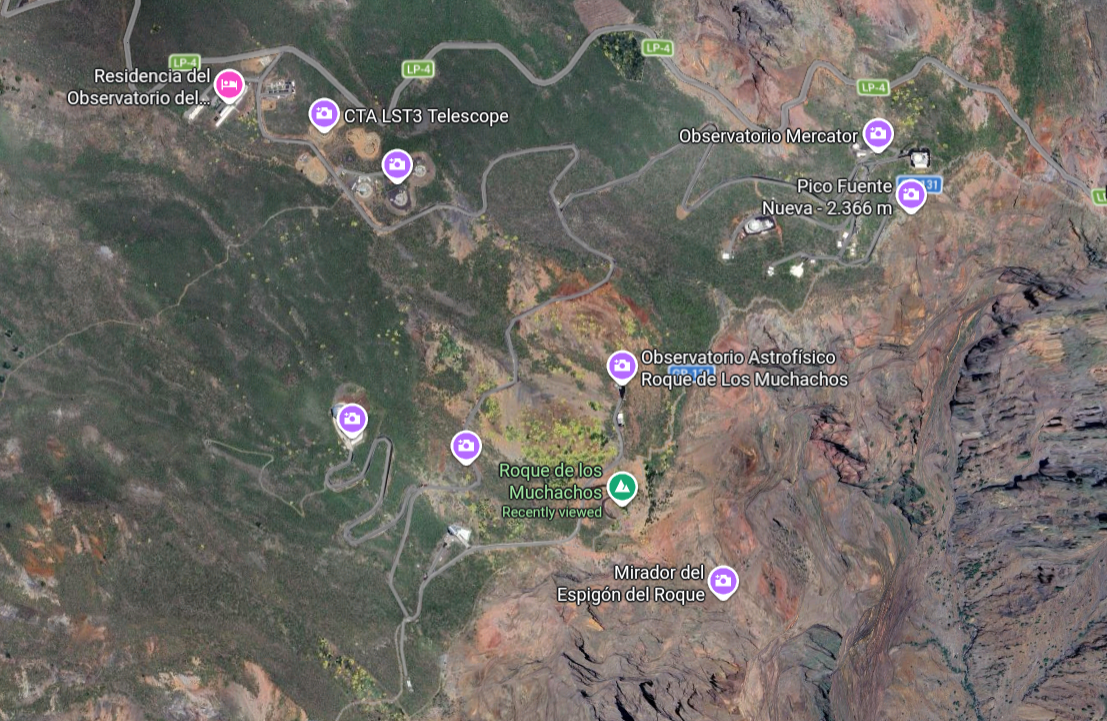
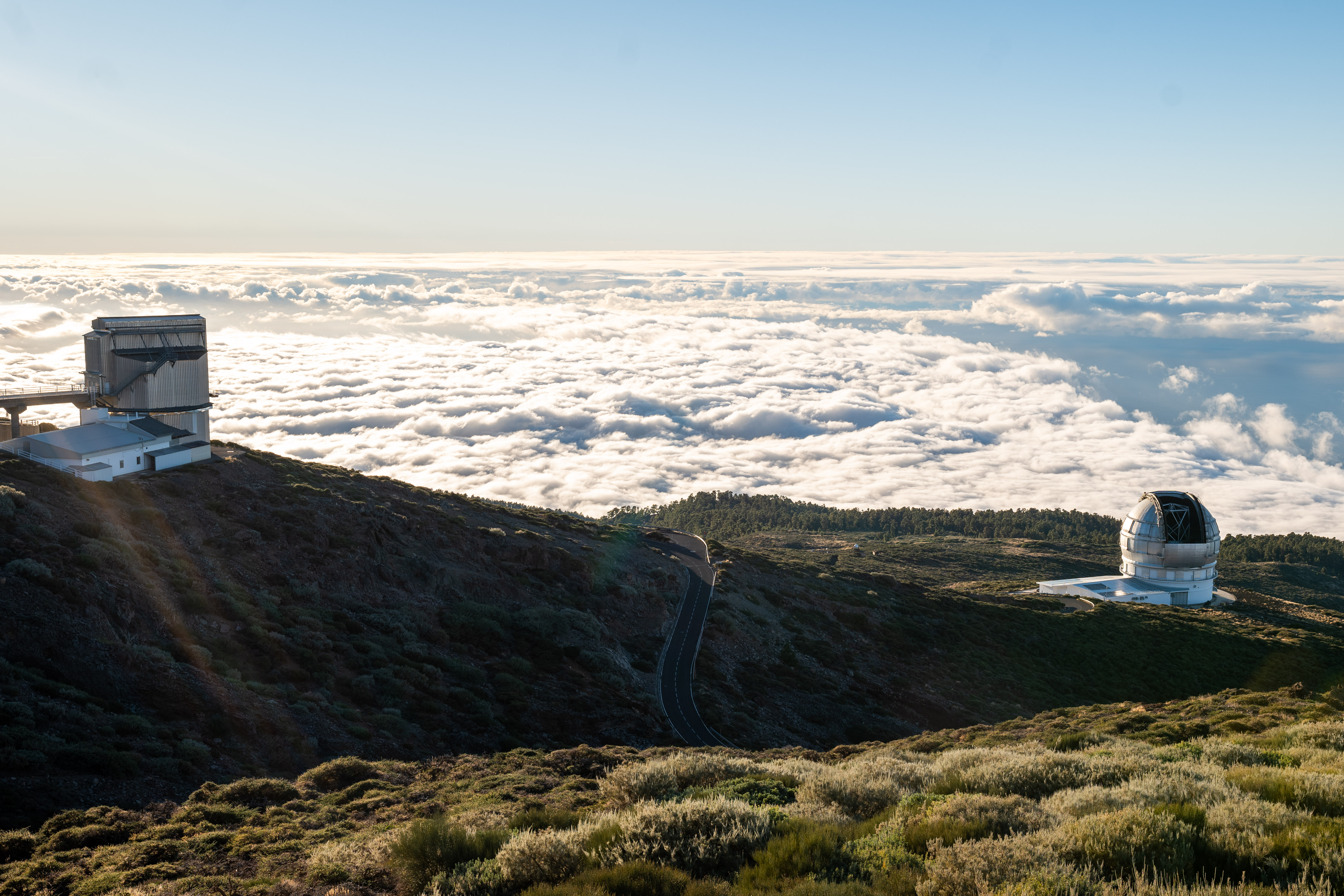
The observatory is split into three main areas. The lowest part is made up of the astronomer lodgings (see below), support buildings, and the Cherenkov telescopes. Travelling up from here you will eventually reach a fork in the road. Turning to the left (east) takes you onto a private observatory road which leads up to Pico Fuente Nueva and the Liverpool Telescope, GOTO, the Mercator telescope, the Swedish Solar Telescope, and the Isaac Newton Group of Telescopes. If you instead carry on straight, the road leads up to the highest point of the island, the Roque de Los Muchachos, as well as the Gran Telescopio Canarias (GTC), the Telescopio Nazionale Gallileo (TNG), and the Nordic Optical Telescope (NOT).
The Residencia (The Resi)
Accommodation at the observatory is provided by the residencia, or ‘resi’, the hotel for astronomers operated by the IAC. Rooms are comfortable and fairly well decorated, if a bit outdated. In many respects it is similar to a normal hotel, bedding and towels are provided (but no pillow chocolates), and there is a laundry service available if you are there long enough to need it.
Food
Some observers are lucky enough to have their own kitchen, either at the telescope like in the William Herschel, or in their apartment for the MAGIC shifters. However most of us make-do with the food provided by the residencia. Up until recently this was operated by Aramark. This is fairly expensive and the quality varies, but you can be sure that you will have enough to eat.
Lunch and dinner are served hot, while breakfast is self-service from a selection of cereals, pastries, and breads. This self service area can also be handy if you need a snack outside of the standard meal times. Hot breakfasts (e.g bacon, eggs, fries) can also be ordered at the window in this area, but knowing some spanish phrases will come in handy. During the night you mostly fend for yourself, either with items from the self-service or by ordering a ‘night snack’ which will be prepared and left in a takeaway bag at dinner time. There’s a selection of snacks and sandwiches which can be ordered, though if you are vegan you often end up with a bag of fruit.
The hot meals must also be pre-ordered, either with the paper sheet found at the reception or online. Make sure to order dinner (and perhaps lunch) for the day you arrive in advance online. There is usually a selection of 3 or 4 items, one for vegetarians, one with meat, one with fish, and the optional item which will be the same all week. Soup and bread is also available.
Water
It is very important to note that while the water at the resi is considered safe, it is not advised to drink from the taps. You will be provided a bottle of water outside the room each day, with more available at meals and from the breakfast room. The water is fine to shower with, but be mindful of conserving water as it is transported by truck from sea level.
While you shouldn’t waste water, it’s also important to drink enough to avoid dehydration. The altitude and very low humidity mean that it is very easy to become dehydrated, which makes getting through the night much more difficult.
About La Palma
The Canary Islands are an archipelago of volcanic islands in the Atlantic which form an autonomous community of Spain, having been colonised in the 1400s. The most commonly spoken language is Spanish and the currency used is the Euro.
La Palma is one of the most volcanically active of the Canaries, and is still growing through new eruptions, the most recent of which took place in 2021.
Geography
The geography of La Palma is dominated by two large parts. In the north is the Caldera de Taburiente, the remnants of a massive volcanic mountain which partially collapsed in a landslide 500,000 years ago and subsequently eroded away. The current landscape takes the form of a massive depression with a rim over 2 kilometers high, the highest point of which is the location of the ORM. The term caldera to describe these features of volcanos was coined by a geologist visiting the Canary Islands.
Towards the south of the island is the Cumbre Vieja ridge, an active volcanic ridge extending as a spine of peaks to the tip of the island. This ridge has been the location of all recent volcanic eruptions on La Palma, three of which have occurred in the past century.
Towns and Cities
Flora and Fauna
Like most isolated islands, La Palma has a large number of endemic species of plants and animals. Fortunately none of which are particularly dangerous, especially when compared to the animals found at the site of GOTO-South in Australia.
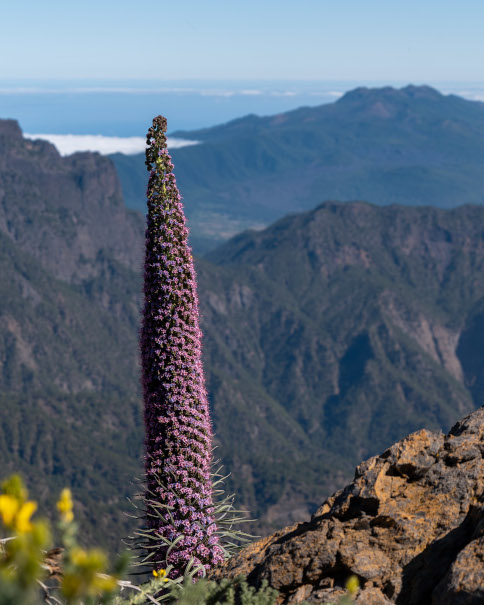
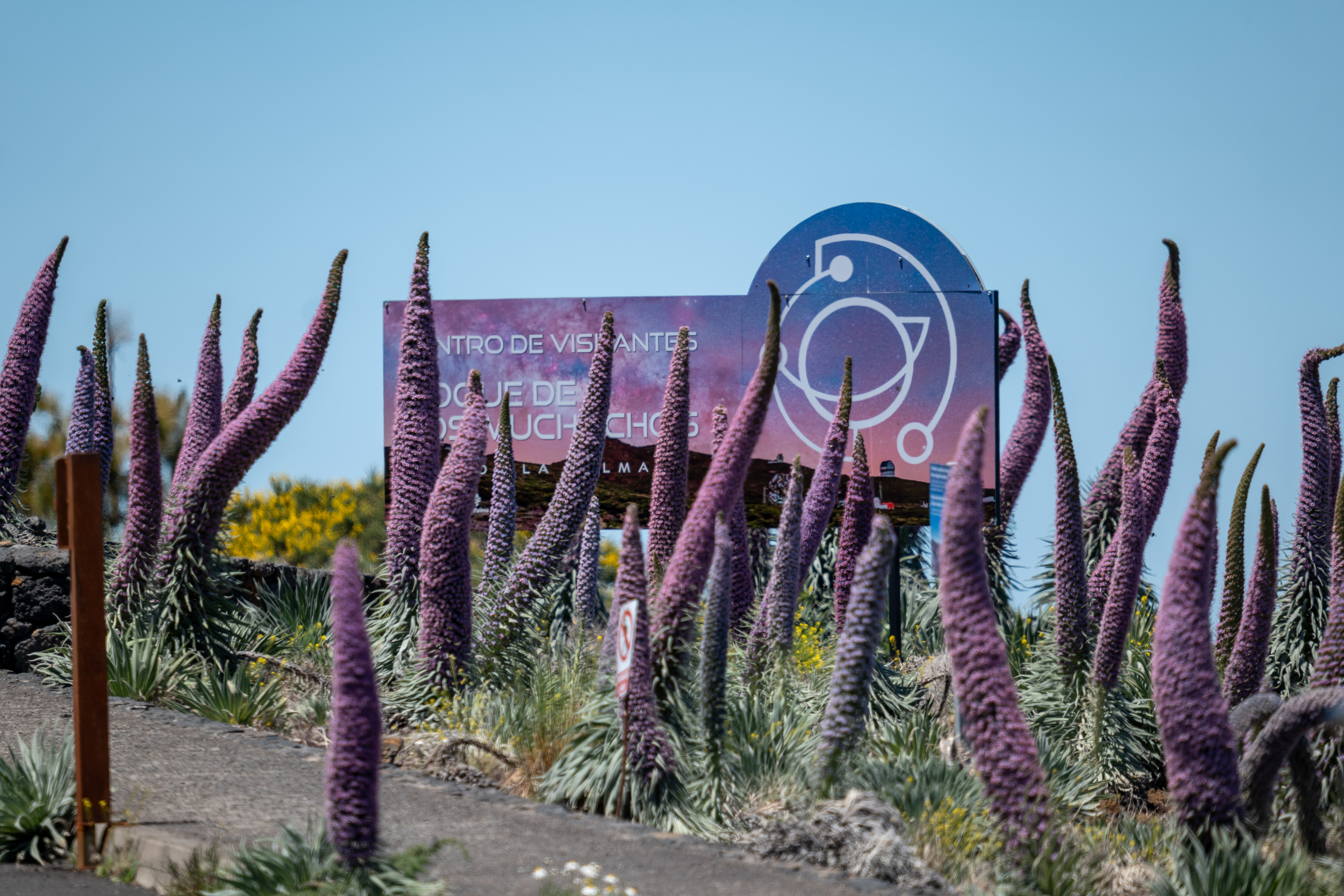
At the Roque keep an eye out for tajinaste, especially during May and June. These are unique to the Canary Islands, and the pink species which grows above the tree line in La Palma is found only there. They are biennial plants, taking two years to grow before they flower for a few weeks in late spring before dying. I always feel incredibly lucky if I manage to be at the observatory during the time in which they are flowering, as they really are impressive to see, towering 2–3 metres tall and covered in vibrant pink. They are also abundant in nectar and attract the local subspecies of honey and bumblebees, which are a striking black and white colour.
La Palma has no native species of mammals other than bats, with all others being introduced by humans. However there are numerous species of birds and reptiles which are unique to the canaries. The subspecies of the Tenerife lizard which can be found near the Roque is particularly striking, with a vibrant blue throat and iridescent scales.
The most distinctive birds are the North African subspecies of red-billed chough (graja) and raven, both of which are often seen soaring over the observatory. The ravens in particular are extremely curious, and would often perch and watch us working on the telescopes during the day.
Things to do
If you are lucky enough to find yourself with free time at the observatory there are a lot of fun things to see and do, both at night and during the day.
Telescope Tours
As a visiting astronomer you will likely see at least one telescope, the one you will be working on. My advice there would be to explore as much as you can and take advantage of the local expertise. Your support astronomer likely knows a lot of secrets about the telescope and will usually be eager to share them with you if you ask.
For other telescopes tours can be either organised or ad hoc. If you know other observers or staff on the island then it is often fairly easy to arrange to view their respective telescopes. Some (in particular the GTC) however will need these to be organised in advance, or at least organised officially.
If you don’t know anyone else who is up then chatting in the dinner room can be a good way to find out what people are working on and if they would be happy to share. This goes both ways of course, whenever I am working on GOTO I make sure to offer tours of it to other astronomers or just tourists who ask. Though if you are a visiting observer make sure you are actually allowed to invite guests in before doing so.
Visitor Centre
The visitor centre of the observatory is a couple minutes down the road, and I think is worth visiting at least once. Usually if you say you are working at the observatory they will let you in for free. The ticket otherwise is a bit pricey (something like 10-15 euro) but you can pay a little more to get a joint ticket for the volcano and archaeology visitor centres elsewhere on the island.
At the visitor centre they have models of some of the different telescopes, various historical items, and some fun demonstrations of things like thermal imaging. The gift shop is also quite nice, but again fairly expensive. There are a lot of tajinaste around as well.
Hiking
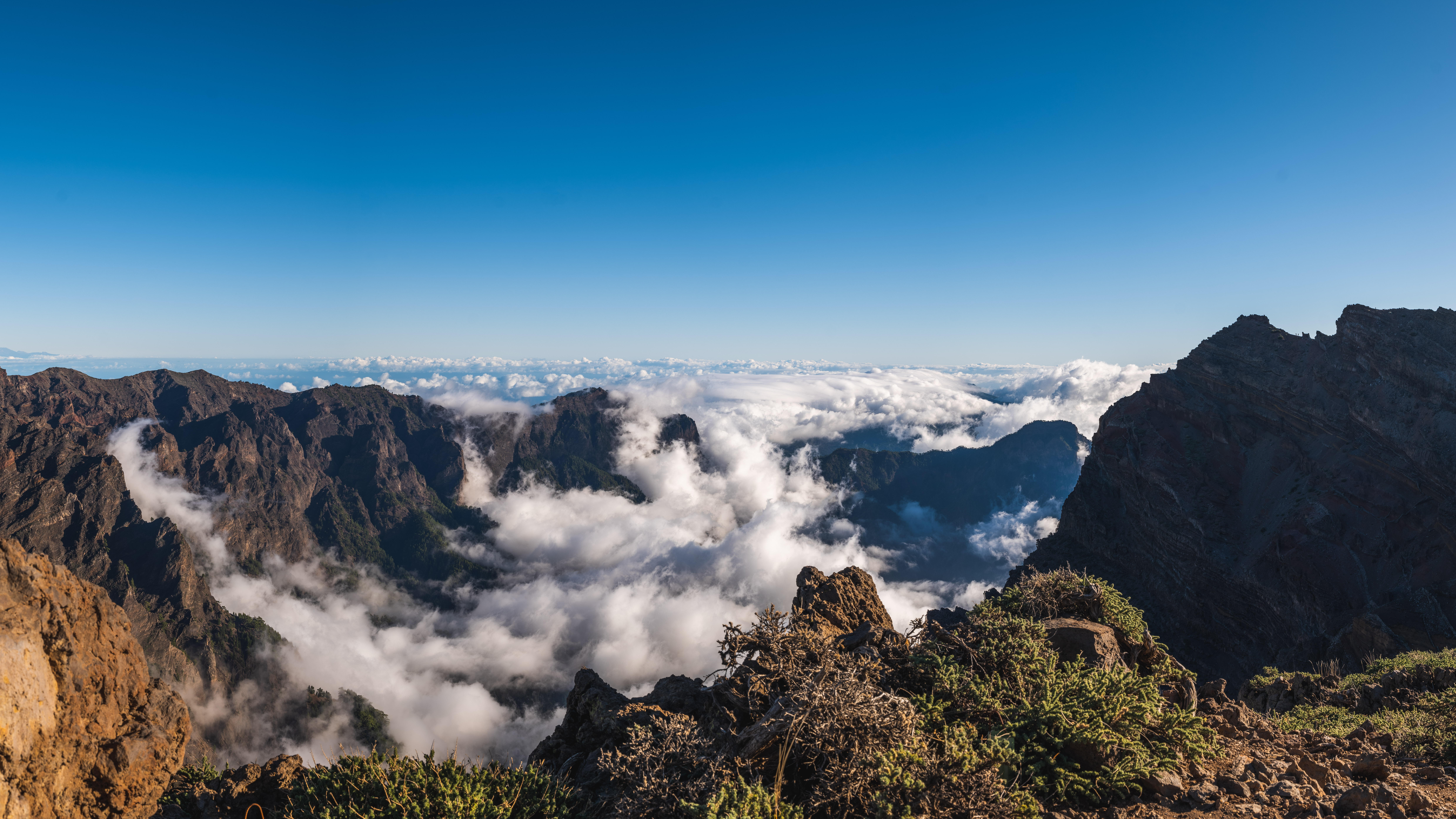
The observatory is covered in hiking trails, particularly up on the ridge of the caldera it is very common to see tourists walking across, there is even an ultramarathon which uses this trail. Walking along the caldera wall is truely breathtaking, especially if there is some cloud below you as it will appear to be spilling over the far ridge (the Cumbre Vieja) and roiling in the caldera below. These trails are fairly rocky, and there is an almost sheer drop to the floor 2 kilometres below in places, so be careful, especially if you are afraid of heights.
Stargazing
Of course the amazing skies are why we come to La Palma. I’d recommend spending some time outside during the night if you can, especially around new moon. Remember that it takes about half an hour for your vision to fully dark-adapt so don’t expect to walk out of a brightly lit control room and immediately be stunned by the stars, give it some time.
If you’re coming from the UK then looking south is particularly exciting. At 28 degrees latitude there are many southern constellations visible from La Palma which are difficult to see from further north. Planets also tend to be higher overhead than in the UK. Taking a look to the North will show Ursa Minor and the North Star much lower than you’re used to.
What to bring
Clothes
Packing clothes for La Palma can be tricky, there is a vast temperature differential between working in the sun during the day and sitting in the dark at night. Bring layers you can easily add and remove throughout the day to stay comfortable depending on when you expect to be working. Even when it is warm it is a good idea to cover up during the day, and/or wear very strong sunscreen. The sun at the observatory is very strong and it is not fun to do an observing run nursing a sunburn.
During the winter rain and even snow are not uncommon so pack a waterproof layer. The wind can also be very strong even in the summer so bring a windproof layer as well.
If you expect to be outside at all during the night (which I would highly recommend!) then bring enough clothes to keep you warm. A hat, gloves, and thermal under-layer are useful even in the summer. Thick socks and boots are also very helpful to avoid loosing heat to the ground.
The observatory is also a lovely place to walk about during the day, but many of the paths are fairly rocky and steep so bring appropriate footwear.
As mentioned before there is a laundry service, but I’ve only stayed long enough to need it once.
Medication and toiletries
I’d recommend bringing a supply of your painkiller of choice, some is available for purchase at the reception but it is expensive and there won’t always be someone there to sell it to you. The same goes for simple first aid supplies like plasters, and blister blasters, as well as hygiene products. Ibuprofen and paracetamol in general are fairly expensive in La Palma without a prescription so I’d recommend bringing it from abroad.
You’ll need to bring your own shower products, but towels (with nice IAC branding) are provided.
Given the very low humidity it can also be nice to bring products to help combat drying out. Lip balm is very useful, especially if it is SPF for use during the day, as is hand cream. Eye drops can also be really helpful. I’ve found that most of my feeling of tiredness during the night is actually caused by dry eyes. I haven’t personally used nasal sprays but they could also be a good idea.
Accessories and electronics
It’s almost always a good idea to bring a head torch, even if you expect to be indoors for most of the night it can be a lifesaver. Amateur astronomers often recommend red lights at night to preserve night vision, but there is fairly good evidence that a faint white light is even more effective while also allowing better colour vision. I’d argue from a scientific point of view a white light would be better to protect the telescopes, as the human eye’s decreased sensitivity to red light means a greater intensity is required for the same quality of vision as a comparable white light, while our telescope instruments are still sensitive to red light.
I always bring a camera to La Palma (sometimes two), as it’s certainly one of the most beautiful places on Earth. During the night it is even more special, and some of my favourite photos have been of the landscape illuminated by the Milky Way. That said, many modern smartphones are fairly capable so don’t feel like you’re missing out if you don’t have a camera. If you do have a camera then bring it!
I also usually bring noise cancelling headphones on my trips, but that is primarily because the ‘control room’ for GOTO is actually a server room and so can be very loud.