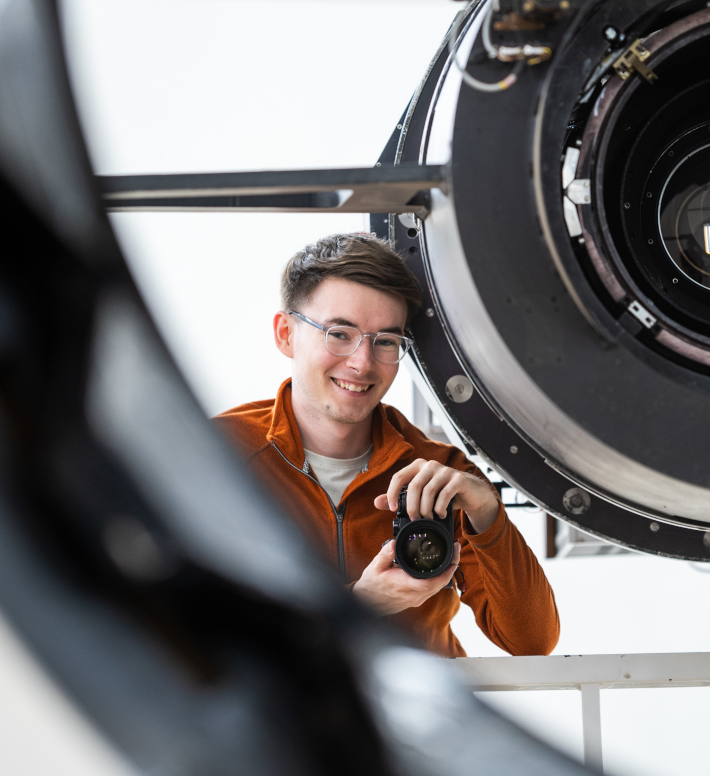
Observational Astronomer
About Me
My research focuses on observational techniques for studying the transient universe, primarily within the optical regime. I’m currently a PhD student at the University of Warwick, working with the Gravitational-wave Optical Transient Observer (GOTO) telescope array.
Previously I completed a studentship at the Isaac Newton Group of Telescopes, where I worked as a support astronomer on the William Herschel and Isaac Newton telescopes.
I’ve been an active astrophotographer for nearly a decade, using a mix of personally owned and professional telescopes. In 2025 one of my images of a supernova discovered by GOTO was chosen as NASA’s Astronomy Picture of the Day Some of my images can be found on Astrobin, though most are shared on my Instagram.
Research
Within the GOTO collaboration my research has mostly centred around the discovery and study of explosive transients (like supernovae) at early timescales, i.e. within a few hours to days of explosion. I led the development of our Fast Analysis and Spectroscopy of Transients (GOTO-FAST) programme, which combines a high-cadence transient discovery survey with real-time spectroscopic follow-up.
Observing
During my PhD, I’ve been lucky enough to have had many opportunities to get hands-on with a wide variety of telescopes.
My first experience at a large observatory was only one month into my PhD, when I travelled to the Roque de los Muchachos Observatory (ORM) on the island of La Palma to carry out operations work for the northern node of GOTO. We spent 10 days on the mountain performing essential maintenance and hardware upgrades, and that was all it took for me to fall in love with the observatory.
Since then I’ve tried to spend as much time as I can working at the telescopes. From spending 3 weeks in Australia helping to commission GOTO-South at Siding Spring Observatory, to spending a year living on La Palma working as a support astronomer. This allowed me to gain experience with a wide range of telescopes, including the Isaac Newton Telescope, the William Herschel Telescope, the Calar Alto 2.2m, and the Nordic Optical Telescope. I’ve also tried my hand outside the optical spectrum as a radio observer by completing the observer training workshop for the Green Bank Telescope.
Astrophotography
Part of what inspired me to study astrophysics was picking up amateur astrophotography in my late teens. Whenever possible I take a camera with me to observatories to take images while we work, and I’m always looking for opportunities to present our scientific data in visually appealing ways.

Southern Cross - Imaged using GOTO-S during commissioning.